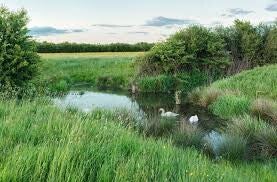
Fencott and Murcott developed as small Anglo-Saxon farming settlements on the edge of the marshlands of Otmoor. Their history has been shaped by agriculture, flooding, drainage, common rights on Otmoor and the gradual consolidation of farms after enclosure. Despite these changes, both hamlets have retained their rural character, historic buildings and strong connection to the landscape.
Ancient origins
The names Fencott and Murcott are both of Anglo-Saxon origin and reflect the landscape in which the settlements developed:
- Fencott means "cottage on marshy ground".
- Murcott similarly means "cottage on the moor" or marsh.
The hamlets grew on the northern edge of Otmoor, an extensive area of wet meadow and marsh. Their position on low-lying ground beside the River Ray has shaped much of their history.
Early settlement
Although there is little evidence of Roman settlement, a Roman road crossed Otmoor west of Fencott and Roman remains have been discovered south of the village.
By 1086 the Domesday estate probably included Fencott and Murcott in the Charlton on Otmoor entry. The population may have consisted of around thirty families, with farming already well established
Medieval farming communities
Unlike Charlton, most land in Fencott and Murcott belonged to the manor of Islip, owned by Westminster Abbey. The Abbey controlled almost all of the land in the hamlets for centuries.
In 1279:
- Around twenty virgates of land were being cultivated.
- Two free tenants and approximately thirty-five villeins and cottars lived in the hamlets.
- Most tenants farmed small holdings and paid rents to the Abbey.
By the late fourteenth century:
- Murcott contained eighteen half-virgaters, five cottagers and a small freeholder.
- Fencott contained eleven half-virgaters and several other tenants.
- Agricultural labour services were gradually replaced by cash rents.
Defining moments
Flooding and drainage
Flooding has been one of the defining features of the hamlets throughout their history.
Fifteenth-century court records regularly mention:
- flooded roads,
- overflowing ditches,
- difficulties travelling between settlements.
A causeway linking Fencott and Murcott existed by the fifteenth century, showing the importance of maintaining access across wet ground. The present road alignment was established after the Otmoor Inclosure Award of 1815.
After severe floods in 1829, nineteen local farmers helped cut the banks of the New River Ray in an attempt to protect their land from flooding.
Population changes
The Black Death appears to have had a relatively limited effect on Fencott and Murcott compared with Islip. Vacant holdings were often quickly taken up by new tenants.
However, during the fifteenth century the population began to decline:
- tenants abandoned holdings,
- labour shortages increased,
- some people left the area altogether.
By 1662 there were:
- 24 households in Charlton,
- 29 households in Fencott and Murcott combined.
The population of the whole parish reached a peak in 1861 before declining again, particularly in the two hamlets.

Our Rural Heritage
The Otmoor Inclosure
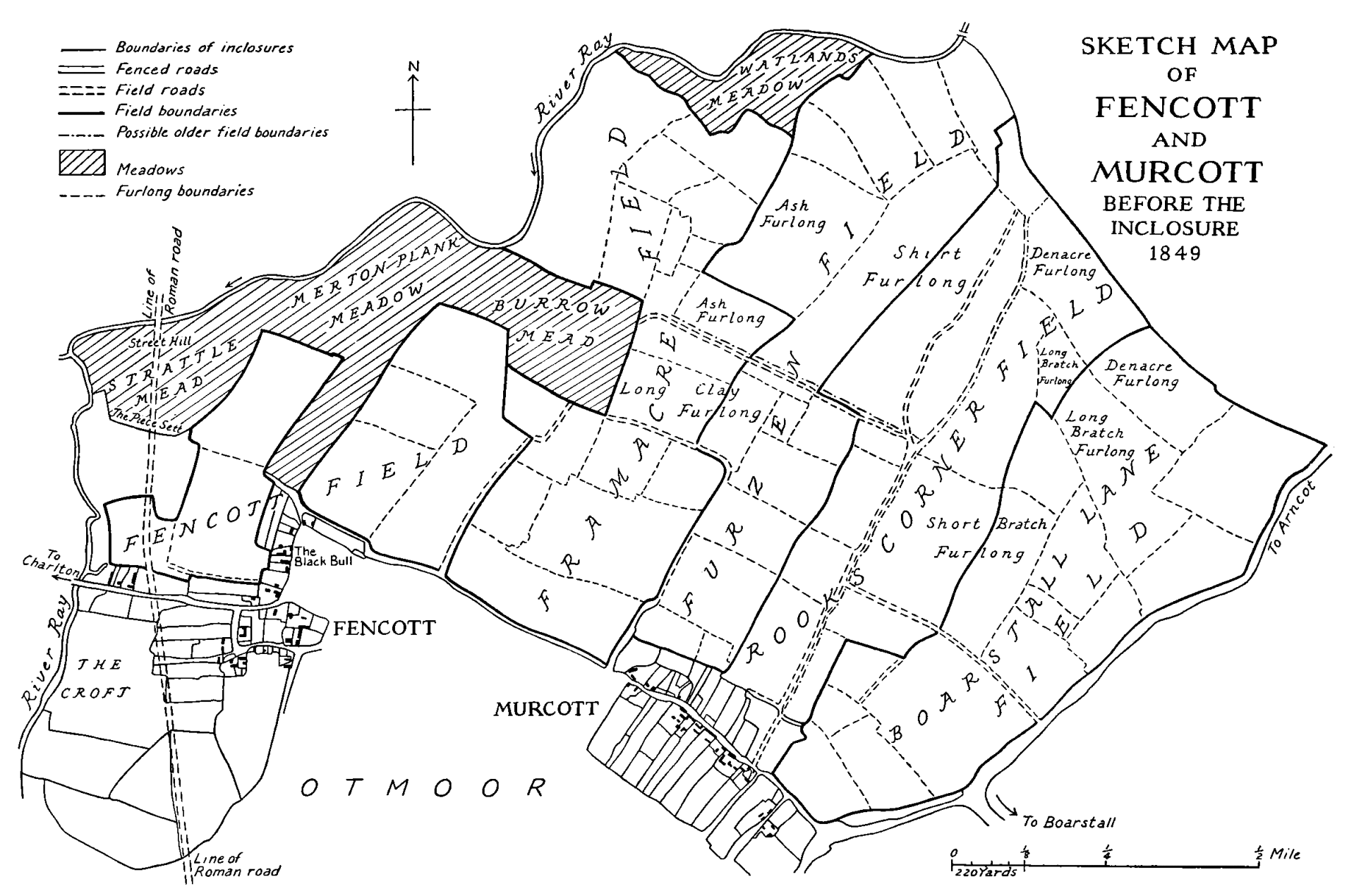
The enclosure of Otmoor in 1815 had a major effect on the hamlets.
Fencott and Murcott received approximately 266 acres under the award, but many smaller landowners could not afford to fence their new holdings and sold them.
As a result small copyhold farms declined, larger farms developed and land ownership became concentrated. By 1849 five farms occupied around 700 acres of the land awarded to the hamlets.
Agriculture
Agriculture dominated life in both hamlets for centuries.
In 1811 55 of 59 families in Fencott and Murcott worked in agriculture.
By the late nineteenth century the number of farms had fallen, holdings became larger and dairying increasingly replaced arable farming. By 1939 most of the land had become permanent grassland.
The area underwent administrative shifts just prior to the war in 1932, when the civil parish of Fencott and Murcott was significantly enlarged by over 2,000 acres as land from Beckley was transferred to it, realigning how the local farms managed the Otmoor terrain.
.
Evolution of our villages
Fencott
The history describes Fencott as:
"a small straggling hamlet on the eastern side of the Ray."
Most of its farmhouses and cottages were built of local stone. One surviving house bears the date 1737 and the initials TWE.
Murcott
Murcott was somewhat larger than Fencott.
Many cottages were built of stone and thatch, while several farmhouses were rebuilt in red brick during the nineteenth century. A Primitive Methodist chapel was built in 1845 and remains within the hamlet.
Inns and social life
Three inns existed in the hamlets during the eighteenth century. These included:
- the Black Bull in Fencott,
- Marlake House in Murcott,
- the Nut Tree at the eastern end of Murcott.
The Black Bull and Marlake House both survived into the twentieth century but had closed by 1939. The Nut Tree remains one of the best-known buildings in Murcott
Nonconformity
Methodism had a strong influence in the hamlets.
A Methodist meeting place existed in Fencott by 1802. Barns in both Fencott and Murcott were licensed for worship during the 1820s and 1830s.
The Primitive Methodist chapel built in Murcott in 1845 served local agricultural labourers and remains a reminder of the strong nonconformist tradition in the area.
First World War and Second World War
During the First World War, the small agricultural community of Fencott and Murcott suffered deeply, losing five young men whose sacrifices are preserved on local roll of honour tablets. Because the hamlets belong to the civil and ecclesiastical parish of Charlton-on-Otmoor, their names are jointly commemorated locally
The original wooden First World War memorial plaque from the closed Murcott Primitive Methodist Chapel is now safely housed inside the Murcott Mission Room on Fencott Road. Their stories are also recorded at the parish church of St Mary the Virgin in Charlton-on-Otmoor
The Fallen Soldiers of the Great War (1914–1919)
- Arthur Cooper: The son of a local agricultural labourer, Arthur worked as a shepherd before enlisting. He served with the Royal Berkshire Regiment and was assigned to a labour battalion.
- George Cooper: Cousin to Arthur and the son of a village carrier, George began working at just 13 years old. He survived multiple major engagements on the Western Front before he was killed in action at age 20 in the trenches near Ypres. [1]
- Arthur Cox: A local estate woodman who volunteered very early in the war at age 23. He was famously positioned in the frontline trenches during the historic Christmas Truce of 1914.
- Albert Honour: Born in Fencott, Albert worked as a farm labourer before answering the call to serve. He fought in the brutal conditions of the Battle of the Somme and witnessed the historic first deployment of tanks on the battlefield.
- Thomas Veary: Raised by his family after his police constable father died when he was 4, Thomas was working as a general labourer by age 14. At age 27, he joined the elite Coldstream Guards and fought extensively across the Somme sector. [1]
World War II Records
Unlike the devastating toll of the First World War, the parish did not suffer mass casualties among its deployed servicemen in World War II, meaning there is no standalone physical WWII fallen soldiers' memorial board located within Murcott itself.
During the Second World War (1939–1945), Fencott and Murcott experienced the war primarily as a localized agricultural hub supporting the British home front.
Fencott and Murcott during the War
The Home Front and Agricultural Expansion
Before the war, much of the low-lying Otmoor basin surrounding Fencott and Murcott was uncultivated wetland or simple pasture. Driven by extreme wartime food shortages and the "Dig for Victory" campaign, the Ministry of Agriculture aggressively drained portions of the Otmoor marshes. Some of the land was ploughed up to grow vital cereal crops and vegetables, forever changing the historic farming practices of the hamlets.
Additionally, the Women’s Institute (WI) and local farm workers organized community efforts to preserve local fruit, pickle vegetables with allocated sugar rations, and knit warm clothing for soldiers serving overseas.
Proximity to RAF Bicester
Fencott and Murcott sit roughly 4–5 miles south of RAF Bicester, which served as a highly active Royal Air Force training station during WWII.
- Wartime Skies: The residents of the hamlets lived directly under the flight paths of Bristol Blenheim, Handley Page Hampden, and Avro Anson bombers training day and night.
- The Otmoor Bombing Range: The wide, flat expanses of Otmoor just south of the villages were utilized by the military as a tactical bombing and firing range, making the sounds of distant detonations a regular part of wartime life for the villagers.
Evacuees and Boundary Reshaping
The hamlets welcomed urban evacuees—primarily children sent away from the heavy bombing of London during the Blitz—who were housed with local farming families.